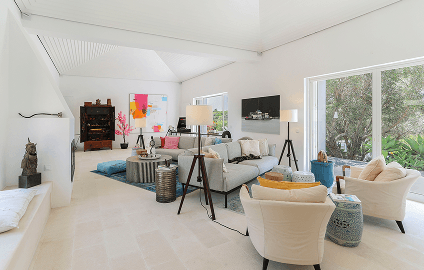
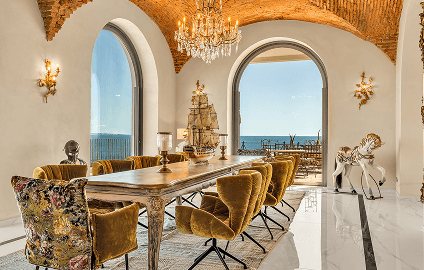
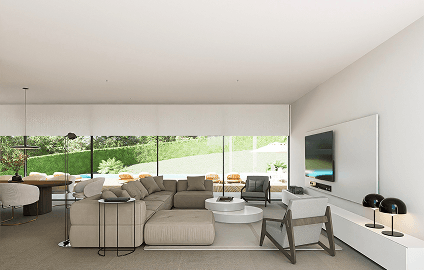
Buyers who spend a season looking at the top end of the Algarve market tend to reach the same conclusion. There are very few finished frontline villas for sale at any given moment, and the ones that exist move quickly. Exclusive Algarve Villas sees this pattern hold across Lagos, Carvoeiro and Vilamoura, and the reason sits in the land itself. The supply of prime coastal villas is held down by protected territory, by conservative municipal planning and by a shoreline that has very little developable frontage left. Understanding why the ceiling on supply is so low helps explain the prices buyers are competing at in 2026.
A Coastline That Is Already Largely Protected
Two of the largest protected areas in southern Portugal frame the Algarve coast. The Ria Formosa Natural Park runs along the central and eastern shoreline and covers roughly 170 square kilometres of lagoon, barrier islands and wetland, protected since 1978. To the west, the Southwest Alentejo and Vicentine Coast Natural Park stretches over 100 kilometres of coast down to Burgau, guarding around 75,000 hectares of cliff and dune. These are not places where new villa development happens. They take long sections of the most scenic coast off the market entirely, which pushes demand onto the finite stretches that remain open to building.
Beyond the named parks, much of the rural hinterland carries a further layer of restriction. Land classified under the National Ecological Reserve, known as REN, or the National Agricultural Reserve, known as RAN, is very difficult to build on, and a plot that falls inside either designation will almost never receive a permit for a new home. Buying a ruin on protected land does not carry a right to rebuild at scale. Exclusive Algarve Villas routinely sees plots that look developable on a map turn out to be encumbered once the municipal classification is checked.
What Municipal Planning Actually Permits
Each Algarve municipality governs building through its Plano Diretor Municipal, the local master plan that fixes what can be built and where. Along the coast these plans are conservative. They cap building height, limit plot coverage and hold firm setbacks from the cliff edge, and the maritime public domain along the shore adds a further protected margin. The effect is that even inside an urban-zoned area, the volume a developer can put on a coastal plot is modest, which is part of why finished frontline homes are so scarce and so costly to replicate.
The one recent loosening of the rules does little for this segment. A 2025 reform let municipalities reclassify rural land for housing with a construction bonus, but the mechanism is aimed at affordable and controlled-cost homes, requires the majority of floor area to serve that purpose, and specifically excludes REN land, coastal protection zones and the better agricultural reserve. It was written to ease the housing shortage for residents, and it does nothing to open the coast to more luxury homes. For the prime segment the practical supply ceiling has not moved.
How Scarcity Shows Up in Prices
Constrained supply against steady international demand produces firm pricing, and the Algarve data reflects it. On the idealista index the national median reached €2,076 per square metre in early 2026, up almost 17 per cent over the year, while the Algarve as a region sits well above that at around €3,100 per square metre. Lagos, one of the agency's core patches, runs higher still at roughly €4,600 per square metre and rising, and the Golden Triangle is in a different band again, with Quinta do Lago around €11,000 per square metre. These figures are the agency's reading of the published index rather than a formal valuation, but the direction is consistent across sources.
The pattern is sharpest at the very top. Where a location combines protected surroundings, a fixed number of frontline plots and a deep pool of overseas buyers, values hold and recover quickly. Scarcity does the work that a rising market usually needs volume to achieve.
Where the Squeeze Is Tightest
The constraint is not uniform across the region, and the patches Exclusive Algarve Villas covers feel it differently. On the Palmares Golf Course near Lagos, finished new-build villas start around €4 million and frontline or golf-frontage homes reach €6 million to €7 million and beyond, with serviced plots between €1.5 million and €3.5 million. There is no mechanism to create more Palmares frontage, so the tier behaves like a closed set. British, Dutch and Irish buyers make up most of the enquiries here.
In Carvoeiro and the wider Lagoa area, clifftop and frontline villas run from about €4 million to €6.5 million, while an unrenovated coastal property sits at €1.2 million to €1.9 million before a renovation budget of €500,000 to €900,000. German and Belgian buyers are well represented on this stretch. Vilamoura offers slightly more turnkey product, from around €1.8 million into a middle band of €2.7 million to €3.5 million and a top end above €8 million, drawing a broad international mix that includes French and American buyers. Across all three patches the finished, well-located villa is the scarce item, and it is the one buyers compete hardest for.
What This Means for Buyers in 2026
For buyers weighing the luxury villas Algarve sellers currently list, scarcity is a structural feature of the market and it is unlikely to ease. The protected coast, the conservative master plans and the reserve designations are permanent, and none of them looks set to relax in a way that adds prime coastal supply. That supports value over the long term, though it also means the right property rarely waits and often trades off market before it is widely advertised. Many buyers arrive for the lifestyle and the climate, then find that the same limited supply underpinning that lifestyle also protects what they pay.
The practical response is to be ready. Buyers who know their target patch, have their financing and their own independent legal representation arranged, and can move when a well-located villa appears are the ones who secure it. Exclusive Algarve Villas works across Lagos, Carvoeiro and Vilamoura to match buyers to the small pool of homes that genuinely fit their brief, and to give an honest view of where a given villa sits on the scarcity and value curve. In a market shaped by limited supply, the advantage lies with the prepared buyer who understands why that supply is limited in the first place.